
The Holy Mountain and the Kingdom: How Mount Athos Came Under Greece
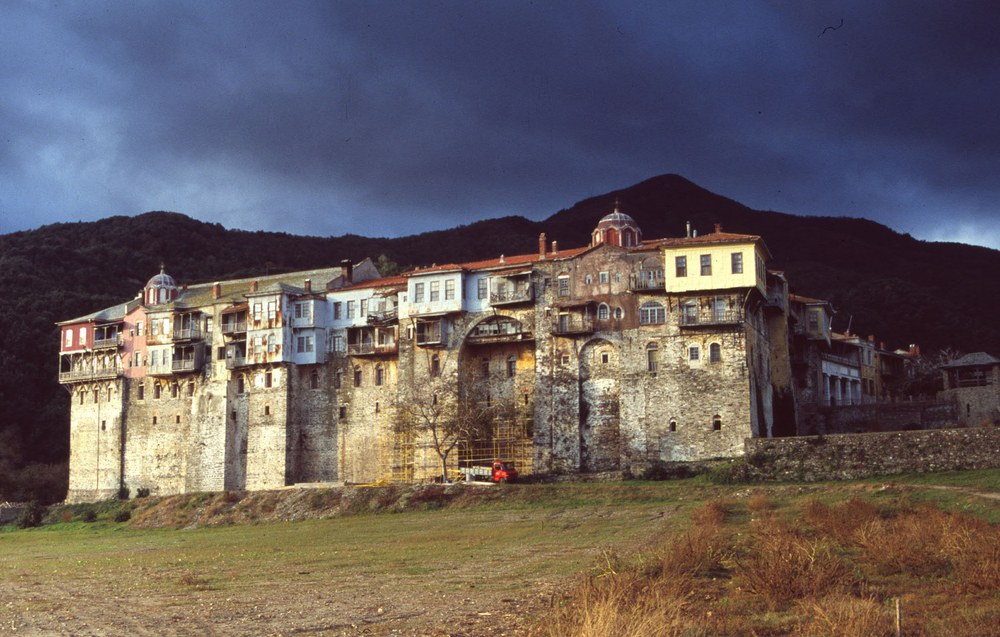
For nearly a thousand years the monks of Mount Athos lived under a succession of earthly rulers while keeping their inner life largely untouched by politics: first the Byzantine emperors, then, after Constantinople fell in 1453, the Ottoman sultans, who left the Holy Mountain its ancient privileges of self-rule even while claiming formal suzerainty over it. That long arrangement ended, suddenly and almost quietly, in the autumn of 1912.
A landing at Dafni
On November 2, 1912, in the opening weeks of the First Balkan War, a small Greek naval party came ashore at Dafni, the harbor that has always served as Mount Athos's gateway to the sea. Accounts vary slightly on the numbers — some put the landing party at around forty sailors — but they agree on what happened next: the men marched the steep path inland to Karyes, the Mountain's administrative seat, where the resident Ottoman official formally handed over authority to the representative of the Kingdom of Greece. Greek commanders were acting partly on reports, credible at the time, that Bulgarian forces advancing through Macedonia — Bulgaria had its own long-standing ties to the Athonite monastery of Zografou — might reach the Mountain first. Centuries of Ottoman suzerainty ended that day without a shot fired on the peninsula itself.
Fifteen years without a settled answer
What followed was not a clean transfer of ownership but nearly a decade and a half of diplomatic uncertainty. Russia, which had long regarded itself as protector of the Orthodox Slavic world and maintained a large monastic community on the Mountain — chiefly at St. Panteleimon Monastery — pressed at the 1913 London Conference of Ambassadors for Athos to become something other than simply Greek territory: proposals ranged from an internationalized zone to a neutral, independent monastic state to a shared protectorate of the Orthodox Balkan nations. The Ecumenical Patriarchate and the Greek government answered half-heartedly; Greece needed Russian goodwill on other diplomatic fronts and was reluctant to press the matter to a conclusion. The Athonite monks themselves, meeting in community — all but the Russian brotherhoods — passed their own resolution, determined to guard the Mountain's ancient self-governing customs from outside interference while at the same time acknowledging Greek sovereignty as the reality already on the ground. In effect, the question was left open: Greek civil administration continued in practice while the Mountain's final legal standing waited on events far beyond it.
A question closed by treaty, and a charter written by the monks
Those events arrived with the First World War and its aftermath. Russia's protection, already weakened, vanished almost entirely after 1917, as revolution and civil war left Moscow with neither the will nor the standing to press Athos's case abroad. Over the following years, a sequence of international treaties closed the question piece by piece — the 1919 Treaty of Neuilly, the 1920 Treaty of Sèvres, and finally the 1923 Treaty of Lausanne, which brought the matter to its formal international conclusion and confirmed Greek sovereignty over the peninsula.
What makes the Athonite settlement unusual is that its final shape was not simply imposed from outside. In 1924, a committee drawn from the Mountain's own monasteries drafted a Charter of the Holy Mountain, setting out in detail how Athos would govern its own internal and spiritual life under the continuing jurisdiction of the Ecumenical Patriarch of Constantinople, even as it became part of the Greek state for civil purposes. The double Synaxis — the full assembly of the Mountain's twenty ruling monasteries — approved the Charter, and in 1926 the Greek Parliament enacted it into law. The following year, Greece's new constitution wrote Athos's special status directly into the nation's founding law, an arrangement every Greek constitution since has preserved.
An arrangement a Byzantine canonist would recognize
The result is a genuinely unusual form of government. A civil governor, appointed by Athens and resident in Karyes, oversees police, customs, and public order, and sits in an advisory capacity at sessions of the Holy Community, the monks' own governing council — while every question of monastic discipline, worship, and spiritual life remains entirely in the hands of the monasteries themselves and, in matters of highest importance, the Ecumenical Patriarchate. Civil sovereignty belongs to one authority; the care of souls belongs to another. It is, in miniature, the same distinction between the things of Caesar and the things of God that the Church has lived out, in one form or another, since its earliest centuries.
A century and more later, the Holy Mountain's deeper life continued largely undisturbed by all of this — the hours of prayer kept, the Divine Liturgy offered, the same handful of monasteries standing where they had stood for a thousand years, now home to monks drawn not only from Greece but from Russia, Serbia, Bulgaria, Romania, and beyond, united in one Church even as the nations around them rose and fell. The empires that once claimed the Mountain — Byzantine, Ottoman, and in their own way the Great Powers of 1913 — have all passed into history. The prayer of the monks, and the Patriarchate's oversight of it, has not.
A short glossary, for readers less familiar with these terms
- Balkan Wars (1912–1913) — two conflicts in which an alliance of Balkan states, including Greece, drove Ottoman power out of most of its remaining territory in Europe.
- Ecumenical Patriarchate — the historic see of Constantinople, which holds a place of honor among the Orthodox Churches and retains spiritual jurisdiction over Mount Athos to this day.
- Holy Community — the governing council of Mount Athos, made up of representatives from each of its twenty ruling monasteries.
- Autonomous Monastic State — Mount Athos's official status today: self-governing in its internal and spiritual affairs, while remaining part of the Hellenic Republic for civil purposes.
© Portal Pascha. This is original content — please share by linking to this page rather than reposting the full text elsewhere.